Supreme Nutrition
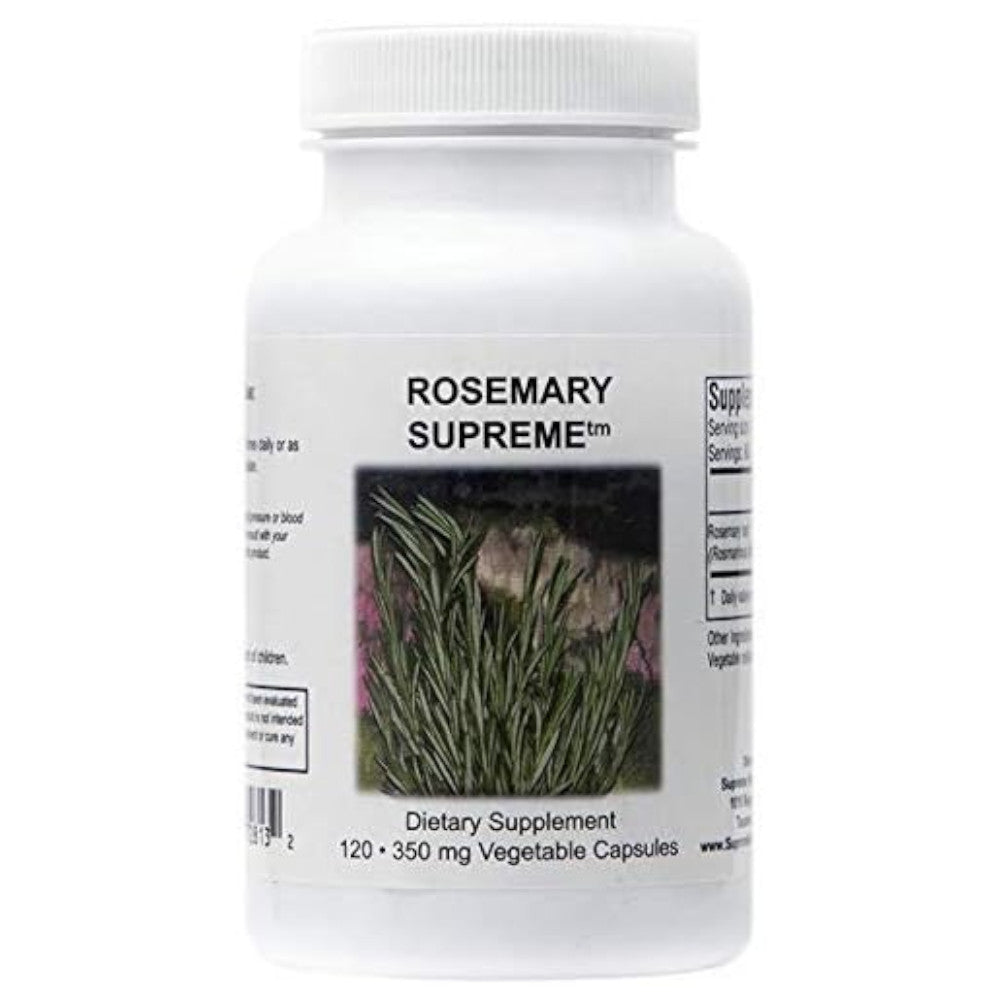
Rosemary Supreme - 120 Capsules
Rosemary Supreme - 120 Capsules
Couldn't load pickup availability
Whole Rosemary Leaf for Cognitive Wellness, Healthy Aging & Inflammatory Balance
Rosemary Supreme provides 350 mg of whole Rosemary leaf (Rosmarinus officinalis) per capsule, offering one of the world's most familiar culinary herbs in a convenient concentrated capsule format.
Rosemary contains a diverse group of naturally occurring plant compounds, including rosmarinic acid, carnosic acid, carnosol, ursolic acid, and other polyphenols. These compounds have attracted research interest for their effects on memory and cognitive performance, antioxidant defenses, healthy inflammatory signaling, cellular resilience, and hormone metabolism.
Key Benefits of Rosemary Supreme
✅ Supports Memory & Cognitive Function – Human studies using dried Rosemary leaf have reported improvements in selected measures of memory and cognitive performance.
✅ Provides Powerful Antioxidant Support – Rosemary contains naturally occurring rosmarinic acid, carnosic acid, carnosol, and other compounds that help support normal cellular defenses against oxidative stress.
✅ Supports Healthy Brain Aging – Rosemary compounds have been studied for their interactions with antioxidant and cellular-protection pathways important to nervous-system wellness.
✅ Supports a Healthy Inflammatory Response – Rosemary polyphenols interact with several pathways involved in normal inflammatory signaling.
✅ Supports Mood & Mental Wellness – Human research has explored Rosemary leaf in relation to memory, mood, anxiety-related symptoms, and sleep quality.
✅ Supports Healthy Hormone Metabolism – Preclinical research has investigated Rosemary compounds for their influence on estrogen-metabolism pathways.
✅ Whole-Leaf Botanical Formula – Rosemary Supreme provides whole Rosemary leaf rather than an isolated rosmarinic acid or standardized extract.
What’s Inside Rosemary Supreme?
Rosemary Leaf (Rosmarinus officinalis): 700 mg per 2-capsule serving
Per capsule: 350 mg
Other ingredient: Vegetable cellulose capsule.
Bottle Size: 120 vegetable capsules
Serving Size: 2 capsules
Servings Per Container: 60
Why Choose Rosemary Supreme?
Rosemary is often thought of simply as a culinary herb, but its leaves contain a surprisingly diverse group of biologically active compounds.
Among the best known are:
- Rosmarinic acid
- Carnosic acid
- Carnosol
- Ursolic acid
- Flavonoids
- Other naturally occurring polyphenols
These compounds interact with several physiological systems, which helps explain Rosemary's traditional reputation for supporting memory, circulation, digestion, and overall vitality.
Rosemary Supreme provides the whole leaf, allowing these compounds to remain together as part of the plant's natural botanical matrix.
Rosemary & Memory
Rosemary has been associated with memory for centuries, and this traditional reputation now has some direct human research behind it.
In a placebo-controlled study involving older adults, different doses of dried Rosemary leaf were tested for their short-term effects on cognitive performance.
A 750 mg dose of dried Rosemary leaf produced a significant improvement in one measure of memory speed, while very high doses did not provide greater benefit and actually worsened some cognitive measures.
This dose-response pattern is particularly interesting because it suggests that more Rosemary is not necessarily better.
A separate randomized clinical trial in university students used 500 mg of Rosemary twice daily for one month. Researchers reported improvements in prospective and retrospective memory along with favorable changes in several mood and sleep measures.
These studies are relatively small, but they provide direct human evidence supporting Rosemary's longstanding connection with memory and cognitive wellness.
Rosemary & Brain Wellness
The nervous system has a high demand for oxygen and energy, which also makes brain tissue particularly sensitive to oxidative stress.
Rosemary compounds such as carnosic acid and carnosol have been widely studied for their ability to interact with cellular antioxidant-defense pathways.
One important area of research involves Nrf2, a signaling pathway that helps cells activate their own antioxidant and protective systems.
Much of this mechanistic research comes from laboratory and animal studies, but it provides a biological basis for Rosemary's broader role in brain and healthy-aging nutrition.
Rosmarinic Acid & Antioxidant Support
Rosmarinic acid is one of Rosemary's best-known polyphenolic compounds.
It has been studied for:
- Antioxidant activity
- Healthy inflammatory signaling
- Immune-related pathways
- Cellular stress responses
- Tissue resilience
Antioxidants do not eliminate oxidation entirely. Normal oxidation is part of everyday metabolism.
Instead, antioxidant systems help maintain an appropriate balance between the production of reactive compounds and the body's ability to neutralize or manage them.
Rosemary's combination of multiple naturally occurring antioxidants makes it especially interesting for cellular wellness and healthy aging.
Supporting a Healthy Inflammatory Response
Inflammation is an essential part of immune defense, tissue repair, and recovery.
Healthy physiology depends on being able to activate inflammatory pathways when appropriate and then regulate those signals as the need passes.
Rosemary compounds including rosmarinic acid and carnosol have been studied for their interactions with several signaling pathways involved in inflammatory regulation.
This makes Rosemary relevant not only for brain wellness but also for broader cellular, immune, metabolic, and healthy-aging support.
Rosemary, Mood & Sleep Research
Cognitive function does not occur separately from stress, mood, and sleep.
Mental fatigue, emotional stress, and poor sleep can all influence memory and concentration.
In a randomized trial involving university students, oral Rosemary supplementation was associated with improvements in prospective and retrospective memory along with favorable changes in anxiety, depression, and sleep-quality scores.
These findings add another dimension to Rosemary's traditional reputation as a botanical associated with mental clarity and emotional well-being.
Rosemary is not primarily a sedative or sleep herb, but its broader nervous-system research makes it relevant for individuals interested in supporting cognitive and mental wellness.
Rosemary & Estrogen Metabolism
Rosemary has also attracted research interest for its effects on estrogen metabolism.
Estrogens such as estradiol and estrone are continually metabolized through several biochemical pathways.
Animal research using Rosemary leaf extracts has found changes in the way these hormones are metabolized, including shifts in estrogen-metabolite pathways.
This research helps explain why Rosemary is sometimes included in practitioner-guided nutritional programs focused on healthy hormone metabolism and liver-related processing pathways.
Human clinical research in this area remains limited, so Rosemary is better viewed as supportive nutrition for normal hormone metabolism rather than as a direct estrogen-lowering botanical.
Rosemary & Liver Metabolism
The liver plays a major role in processing hormones, medications, environmental compounds, and metabolic by-products.
Rosemary compounds have been investigated for their interactions with several liver enzyme systems involved in normal metabolic processing.
This connection between antioxidant support, liver metabolism, and hormone processing contributes to Rosemary's broader role in nutritional wellness.
Healthy liver function also depends on adequate nutrition, healthy body composition, regular movement, appropriate alcohol exposure, and other lifestyle factors.
Microbial & Biofilm Research
Rosemary has also been studied extensively in laboratory settings for interactions with bacteria, fungi, and microbial biofilms.
Researchers have investigated Rosemary extracts, essential oils, and individual compounds against a variety of microorganisms.
This research demonstrates that Rosemary possesses meaningful botanical activity, although concentrated extracts and essential oils used in laboratory experiments are different from whole Rosemary leaf capsules.
For everyday nutritional use, Rosemary Supreme is better suited to broad antioxidant, cognitive, and physiological support than to use as a stand-alone antimicrobial product.
Whole Rosemary Leaf vs. Concentrated Extracts
Rosemary products can vary considerably.
Research may involve:
- Whole dried Rosemary leaf
- Concentrated Rosemary extracts
- Essential oil
- Purified rosmarinic acid
- Carnosic acid
- Carnosol
- Other isolated constituents
These forms should not be considered interchangeable.
Rosemary Supreme provides whole Rosemary leaf, preserving the naturally occurring spectrum of plant compounds rather than concentrating one specific constituent.
This whole-leaf format is especially notable because some of the available human cognitive research has also used dried Rosemary leaf powder, rather than only highly concentrated extracts.
Who May Prefer Rosemary Supreme?
✔ Individuals interested in memory and cognitive wellness
✔ Those seeking additional antioxidant and cellular support
✔ People interested in supporting healthy brain aging
✔ Individuals looking for botanical support for a healthy inflammatory response
✔ Those interested in the connection between cognition, mood, and mental wellness
✔ Individuals incorporating nutritional support into a broader hormone-metabolism program
✔ People who prefer a whole Rosemary leaf formula rather than an isolated botanical extract
Suggested Use
Take 1–2 capsules, 2–3 times daily, or as directed by your physician.
Important Information
If you are taking blood-pressure medication or blood-thinning medication, consult your physician before using Rosemary Supreme.
Individuals taking prescription medications or managing a medical condition should consult a qualified healthcare professional before use.
Keep out of reach of children.
These statements have not been evaluated by the Food and Drug Administration. This product is not intended to diagnose, treat, cure, or prevent any disease.
Share